
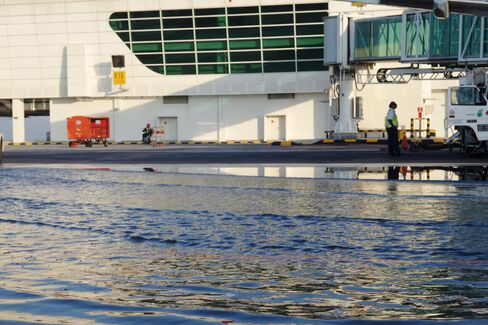
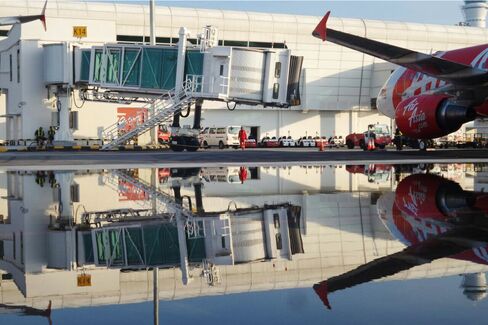
Kuala Lumpur International Airport’s new budget passenger terminal is sinking, with cracks appearing in the taxiway and water forming pools that planes must drive through.
The defects could cause flight delays, increase wear and tear on planes and pose potential safety risks, according to AirAsia Bhd., the new terminal’s biggest user. Though take offs and landings aren’t affected, the carrier has asked Malaysian authorities to fix the problems before passengers get hurt, Chief Executive Officer Aireen Omar said in an interview in Kuala Lumpur.
“The airport is still sinking,” Aireen said. The operator, Malaysia Airports Holdings Bhd., “has done some partial resurfacing, but what the airport actually needs is a permanent solution.”
Complaints about the new terminal cap a bad run for Malaysia’s aviation industry, after two deadly accidents for the national carrier — the unsolved disappearance of Flight MH370 in March 2014 and the shooting down of another plane over Ukraine last July. Construction expenses for klia2, as the new terminal is known, ballooned from an initial estimate of about 1.7 billion ringgit ($446 million) to 4 billion ringgit.
“Since MH370, a lot of shortcomings have been found” in Malaysia’s aviation infrastructure, said Shukor Yusof, founder of Singapore-based consultancy Endau Analytics. “The authorities haven’t done enough to address these shortcomings, not enough to put them on par with the First World.”
Shares of Malaysia Airports fell 1.1 percent to close at 6.06 ringgit in Kuala Lumpur, while AirAsia was unchanged at 1.40 ringgit. The benchmark FTSE Bursa Malaysia KLCI Index dropped 0.6 percent.
Ponding
The Transport Ministry has set up an independent audit committee, which will submit a report on ponding issues “in due course,” the ministry told Bloomberg. Malaysia Airports, which has used its own funds to rectify the situation, “will be responsible for the findings and proposed solutions,” the ministry said in an e-mail.
AirAsia initially refused to move when klia2 opened in May 2014, citing concerns over flight operations and security. The carrier gave in after the government said it would stop immigration and customs services at the old budget terminal.
“We should never have moved,” Tony Fernandes, AirAsia’s co-founder and group CEO, told reporters in Kuala Lumpur Monday. “I was right, the management of AirAsia was right: You should have let the ground settle, fix it, then move.”
The AirAsia group of airlines flew 15.2 million passengers through klia2 in its first year of operation, accounting for 87 percent of the terminal’s traffic, according to Malaysia Airports data. Tiger Airways Holdings Ltd., Cebu Air Inc. and Malindo Air declined to comment on their experience at the new terminal. An official from Lion Mentari Airlines PT didn’t respond to requests for feedback.
Waterlogged Tarmac
“If you go to the airport you can see ponding with your very own eyes,” said Mohshin Aziz, an analyst at Malayan Banking Bhd. in Kuala Lumpur. Still, he noted, “it’s more of an irritation rather than a safety hazard.”
Last year, local media photographed Transport Minister Liow Tiong Lai and airport officials walking through the terminal’s waterlogged tarmac during an inspection.
Construction of klia2 started in 2009 after the growth of low-cost travel, particularly by Malaysia-based AirAsia, pushed passenger traffic beyond the existing budget terminal’s capacity. At 257,000 square meters, klia2 can handle 45 million passengers, with the potential to expand.
Most full-service carriers, including Malaysia Airlines, use the main KLIA terminal, which began operations in 1998 about 50 kilometers (30 miles) from Kuala Lumpur after the government relocated the capital’s main airport from suburban Subang.
Malaysia Airports said the depressions and ponding at klia2 were caused by differential soil settlement in the apron and taxiway, where some of the structure is built on piling and some stands on normal ground.
Bangkok, Kansai
The settling “has been anticipated from the start of construction,” Malaysia Airports said in an e-mailed response to questions. Stakeholders such as AirAsia are updated weekly on the progress of the maintenance and are “constantly engaged on operational issues.”
The airport is addressing the issue by patching and resurfacing problem areas and injecting polyurethane under the ground. A concrete slab to be completed by next April will provide a more permanent solution, Malaysia Airports said.
Fernandes said today he is frustrated with the airport operator.
“Do you have bumps in the airport, do you have works being done, do you have an aircraft wheel being bent?” Fernandes said. “You name me an airport that you expect this to happen. If it’s a mistake that has happened, it’s happened. Let’s fix it. Let’s not pretend that it’s not there.”
Klia2 isn’t the only Asian airfield to face difficulties getting off the ground.
Bangkok’s Suvarnabhumi airport, which opened in 2006 atop a reclaimed swamp, suffered from cracks at taxiways and runways and faulty baggage-scanning machines. Airports of Thailand Pcl was forced to close some taxiways for repair and reopen the old airport to alleviate congestion. The company’s president quit amid probes of the construction flaws, citing health reasons.
In Japan, the government had to reinforce landfill under Osaka’s Kansai International Airport after it was found to be sinking. Opened in 1994, the facility took almost eight years and 1.43 trillion yen ($12 billion) to build on a manmade island.
“It’s about time aggressive steps are taken to improve standards in Asia,” said Mark D. Martin, chief executive officer of Dubai-based aviation consulting firm Martin Consulting. It’s bad for the region “that we have to see such incidents and events that negatively affect the safe operation of an aircraft or airport.”