

MALAYSIA faces greater economic risks because of the high debt and risk exposure from on-going mega projects funded by Chinese banks, PKR-affiliated think tank Institut Rakyat said in a policy paper on Chinese investments.
Its director Nurul Izzah Anwar, who presented the paper at a forum last night, said Malaysia’s debt was a “a well-known fact”, with current federal government liabilities amounting to RM685 billion as at second quarter of 2017, according to Bank Negara.
“By engaging in multiple mega projects, the Malaysian government may be inflicting pain upon Malaysians in the long term as these projects are funded via soft loans from Chinese banks which must be paid with interest,” said Nurul Izzah, at the Kuala Lumpur-Selangor Chinese Assembly Hall.
The paper, “Impact of China’s Investments in Malaysia”, mentioned the China Development Bank, China EximBank and the Agricultural Development Bank of China as some of the lenders to Malaysia.
Nurul, who is also Lembah Pantai MP, said Malaysia must take note of China’s recent implementation of capital controls to slow down the outflow of money.
“Many projects in the pipeline are dependent on funds from China,” she said, adding that there is the possibility of the projects being stalled.
“Therefore, the risk of Malaysia being indebted to China, or failing to complete the projects, is consequential – and needs to be clearly detailed out.”
Prime Minister Najib Razak’s administration has been criticised for relying too heavily on Chinese funding for big projects such as the East Coast Rail Link (ECRL), and over Chinese participation in major projects including the Tun Razak Exchange, Forest City in Johor and various port projects. Nationalists Malay groups have expressed concern that Malaysia was giving up its sovereignty to China, forcing Najib to issue a denial.
The paper also raised doubts that there would be transfer of technology or knowledge to Malaysians through the projects.
“It is unclear whether Malaysians would gain new knowledge or if there would be limitations as to what can be shared,” said Nurul Izzah.
Another risk for Malaysia could come through China’s economic dominance in strategic locations such as Kuantan and Malacca which have ports in important waterways, namely the South China Sea and the Straits of Malacca, respectively.
“China’s influence in these strategic locations may affect the relationship between Malaysia and its neighbours,” she said.
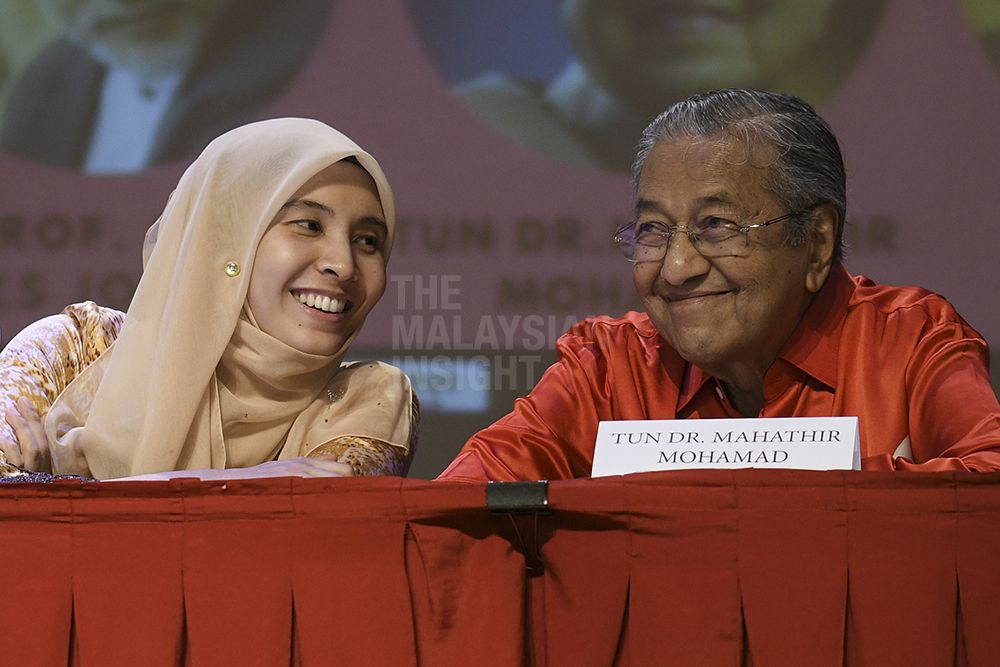
Nurul Izzah shared the stage at the forum with former prime minister Dr Mahathir Mohamed, and economists Professor KS Jomo and Azrul Azwa.
Nurul Izzah said it was difficult to obtain information on some of the Chinese projects as some figures were not disclosed, and cited as an example the portproject in Bagan Datoh.
“We talk about projects but it is difficult to obtain a list,” she said.
She also stressed that opposition pact Pakatan Harapan was not anti-China and was pro-investment. However, no country should be given a blank cheque when investing in Malaysia and that includes China which is Malaysia’s top trading partner.
Jomo, meanwhile, echoed concerns about the impact of China’s capital flight controls on China-backed projects in Malaysia.
The problem, he said, was if these projects were used to obtain loans, which would add to the burden of Malaysia’s future generations who would have to repay them.
The economist also told the forum that Malaysia’s “premature de-industrialisation” was a sign of failure because the industrialisation had started to contract before it has matured.
“Our industrialisation economy has not fully matured and it has already shrunk. This is a big challenge but unfortunately, it is touted as a success. Apparently it shows that we are heading toward (becoming) a more successful economy and a developed country.
“This is in actual fact a failure, but is said to be a success,” said Jomo.
He also questioned whether the Malaysian economy could rely on the services sector, such as financial services, for growth, and asked if that was what the country was aiming for. – August 25, 2017.