
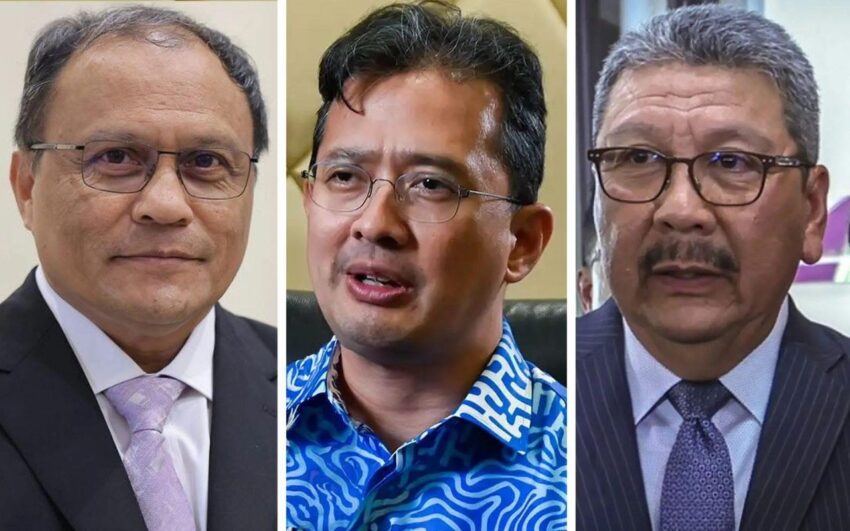
The government’s decision to establish a special committee to investigate allegations involving the Chief Commissioner of the Malaysian Anti-Corruption Commission, Tan Sri Azam Baki, raises serious concerns when viewed against Malaysia’s own recent institutional history.
In substance and structure, the present special committee is strikingly similar to the multi-agency task force formed in 2015 to investigate the 1MDB scandal linked to former Prime Minister Najib Razak. That earlier task force included the Attorney General as one of its key members.
The outcome of that arrangement is now well known. The task force was widely perceived as farcical and ultimately became a dismal failure, collapsing amid controversy, institutional interference, and a loss of public confidence. Rather than enhancing credibility, its composition undermined trust in the integrity of the investigative process.
It is precisely for this reason that the inclusion of the Attorney General as head or member of the present committee raises profound concerns. The experience of 2015 demonstrates that such an arrangement creates an inherent perception problem, particularly where the same office ultimately retains prosecutorial discretion.
Public confidence in any investigation into serious allegations of wrongdoing depends not only on actual independence but equally on the perception of independence. A committee cannot command legitimacy if its members are seen to be institutionally linked to the very system whose conduct is under scrutiny.
The lesson from the 1MDB task force is clear: investigative bodies tasked with examining matters of national importance must be composed of individuals who are both independent and seen to be independent.
Without this essential safeguard, the process risks being dismissed as a mere institutional exercise lacking credibility.
The present committee, as currently constituted, risks repeating the same structural flaws that plagued the earlier task force. This is particularly troubling given the seriousness of the allegations involved and the potential implications for public trust in governance institutions.
If the government is truly committed to transparency and accountability, it must ensure that any investigative mechanism established in this matter reflects genuine institutional independence rather than replicating models that have previously failed.
In the circumstances, the key members of any committee investigating these allegations must be persons who have no direct institutional interest in the outcome and whose impartiality is beyond reasonable question.
If the government truly values its integrity and its repeated public commitment to fight corruption without fear or favour, then it must demonstrate that resolve through concrete action. In this regard, I support and echo the call made by Wong Chen to appoint Tengku Maimun Tuan Mat to chair an independent committee to investigate these serious allegations.
She is widely acknowledged by a vast majority of Malaysians to possess impeccable credentials, unquestioned integrity, and a proven record of independence. Her involvement would immediately lend credibility, public confidence, and legitimacy to the investigative process.
Ultimately, in matters of such national importance, justice must not only be done but must manifestly and unquestionably be seen to be done.
Teresa Kok